
From Ancient Pottery to Modern Creativity
Discover the fascinating journey of ceramics, from ancient pottery in Mesopotamia and Greece to today’s creative clay projects. Learn about techniques, evolution, and an easy DIY air-dry clay craft.
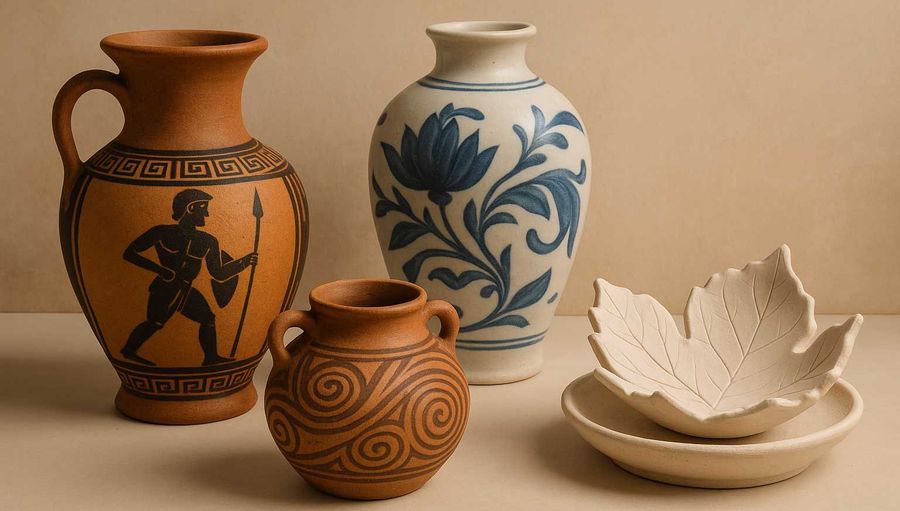
Historical
The art of pottery – in the broad sense of the word – dates back to prehistory , with some authors placing its origin in the first half of the Mesolithic, 8-10 millennia ago. Prehistoric man noticed that the clay in certain areas retained rainwater. It is possible that a footprint imprinted in the wet soil suggested to him the idea of making containers from wet clay. These were roughly shaped by hand and dried in the sun.
Artistic ceramics have been manifested everywhere, so there is not a history of ceramics, but as many histories as civilizations. However, based on the known remains, the oldest center of ceramics can be located in Western Asia, in the coastal lands where the current Turkish Anatolia extends, to Palestine, and inland to Iraq. This industry developed in Egypt, from where it spread to Asia and Europe, starting with the 6th millennium BC.
The first clay objects, dried in the sun, did not withstand the passage of time. Bricks resisted better because they were laid in layers. The first molded bricks appeared in Mesopotamia at the end of the 5th millennium BC. In Egypt, in the same millennium, there was already a pottery industry: clay from the Nile Valley allowed for the production of red or brown objects, while porous gray containers were made from clay marl. The mixture of clay and water was obtained by trampling underfoot in a hole dug in the ground.
For a long time, clay objects were shaped by hand. Although the exact moment of this event is difficult to pinpoint , the “ potter’s wheel ” led to a significant advance in the art of pottery. No one can say precisely when it was conceived, but the first evidence of the existence of the potter’s wheel dates back to Mesopotamia in 3500 BC. A piece of clay, which until then had been shaped by hand, could be “thrown” onto the wheel and spun, and with the help of hands and, possibly, some tools, and through inertial force, it could be given a symmetrical shape. Among these shapes were cups, pots and other containers. Having a destination not only decorative, these vessels represented the only safe way to store food, drinks, oils and cereals, and had many other uses. Clay pots were not only produced for storing various commercial goods, they were themselves objects of trade, traded between different peoples with the help of ships and carts.
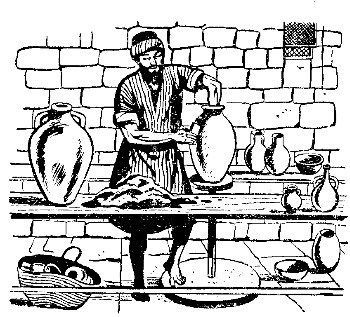
The art of ceramics in Ancient Greece reached a high level of artistic quality, constituting a testimony to the life and culture of the ancient Greeks. The number of Greek ceramic objects catalogued is huge but represents only a tiny part of the production of the era (over 50,000 vessels come from Athens alone). Between 1050-900 BC, ceramic objects were decorated with lines, semicircles, concentric circles, drawn by hand or with a brush.
Simple decorations that adapt to the shape of objects. Geometric art flourishes between the 9th and 8th centuries BC and is characterized by meanders, triangles and other geometric figures. The ceramics of Corinth , which is very developed, are exported throughout Greece.
Around 800 BC, figurative decoration appears: friezes with animals: horses, deer, goats, etc. alternating with bands of geometric motifs. Gradually, the decoration becomes more complicated. Stylized human figures appear. Starting with the 7th century BC, the black style appears, invented in Corinth and resumed by Athens, which takes it to its peak. It is characterized by the representation of figures (lions, goats, hydras, mythological motifs, etc.) in black on a reddish background of clay, and by the use of incisions. Around 530-520 BC, the red style (on a black background) prevails. Female and male bodies are particularly distinguished.
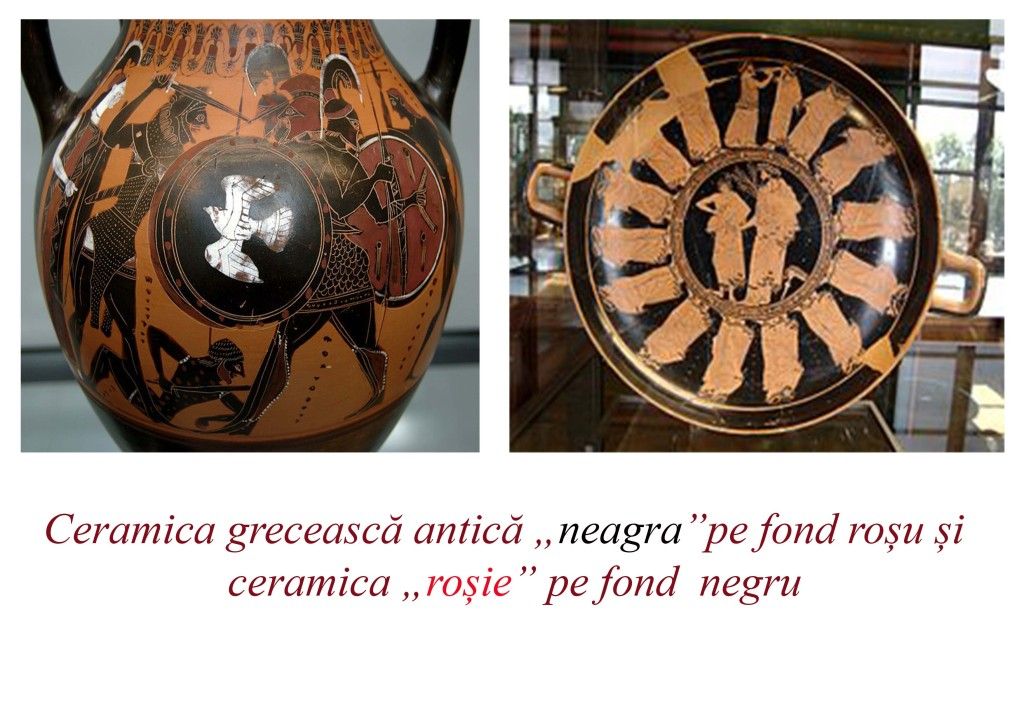
Between 480-479 BC, during the Persian Wars, Athens was occupied by the Persians and the pottery workshops were destroyed. After their restoration (5th century BC), the artisans (painter) adopted a new style (the red style was preserved) in which we find decorative elements (plants, flowers). The polychrome paintings are more elaborate, the painters showing special care for the shades and transparency of the garments.
For a long time, clay objects were dried in the sun for months. Then it was seen that fire greatly shortened this operation and increased the resistance of the objects. However, people were far from inventing the oven. Burning was done on the ground or in specially dug pits, with combustible materials being placed between and under the clay objects. Burning done in this way, at low temperatures (500-600 degrees Celsius), was more of a forced drying. Because there was not enough air during combustion, the gases blackened the clay. Closed ovens, which in the Middle Ages ensured a burning at 800-900 degrees Celsius, appeared around 3000 BC in Syria.
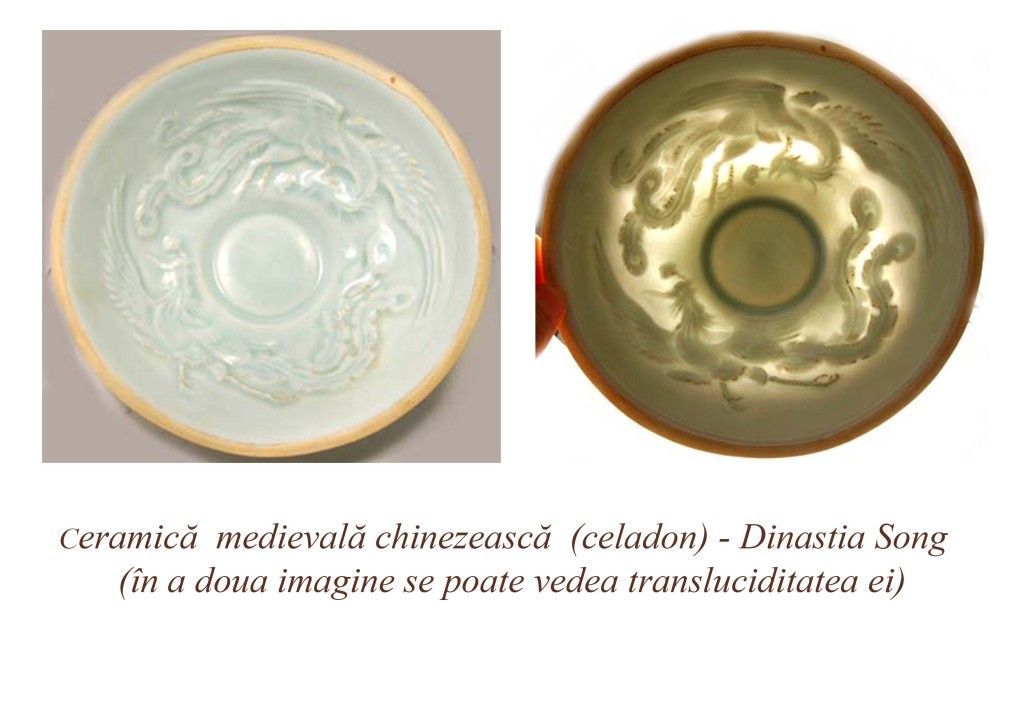
In the 5th century BC, the Chinese invented fine ceramics, and in the 2nd century BC they perfected kilns and achieved temperatures of about 1200-1300 degrees Celsius. Porcelain also appeared in China, and the Chinese even today produce the highest quality porcelain. The first porcelain was a crude substance, obtained during the Tang Dynasty, between 618-907 AD, being highly valued for its translucency. Porcelain reached Western markets in a more refined form in the 13th century, brought by spice merchants traveling to the Far East.
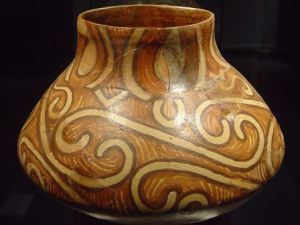
And on the territory of Romania, special ceramic cultures have been discovered, among them that of Cucuteni , being the most famous. Cucuteni is a commune in Iaşi County, where archaeological excavations carried out between 1885 and 1910 revealed Neolithic vestiges dating back to 4,000-3,000 BC. The Cucuteni culture was widespread in Moldova, northeastern Wallachia, southeastern Transylvania and Bessarabia, characterized by a very high-quality ceramic from a technical point of view, richly and variously painted. The ceramics of the Cucuteni culture are unique in Europe, finding some similarities, quite striking, between it and that belonging to a Neolithic culture in China. The latter, however, appeared after a very long time, about a millennium compared to that found between the Carpathians and the Dnieper.
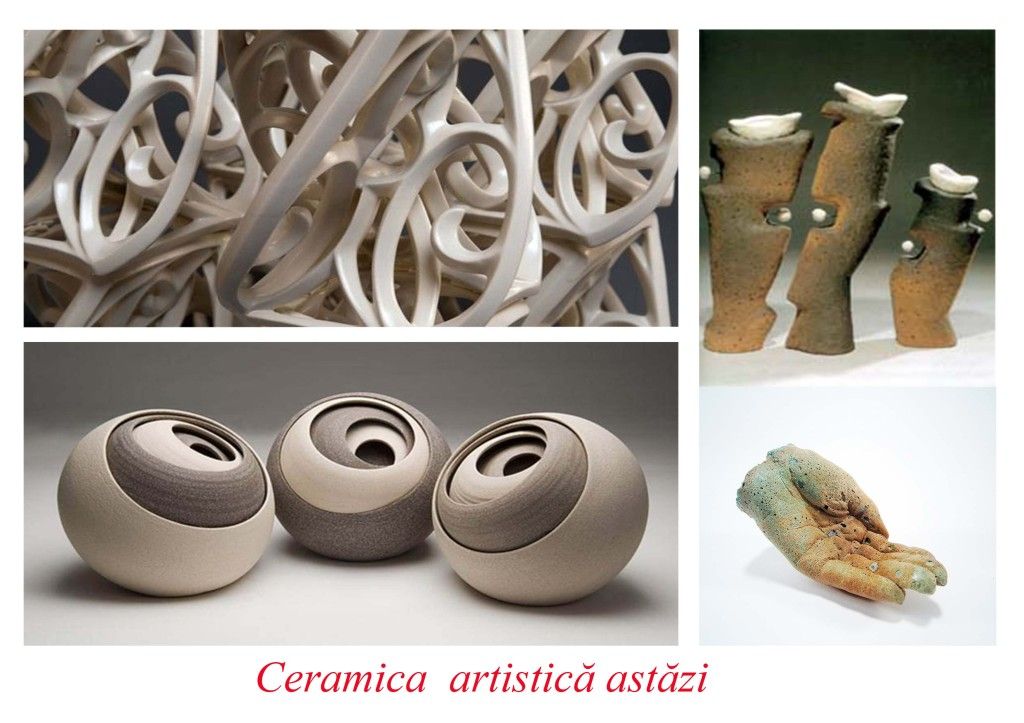
Today, the art of ceramics has long surpassed its simple utilitarian-practical function and has become a stand-alone art form, with unique and distinctive forms of expression.
Here is a simple project that imitates the art of fired ceramics, but which anyone can easily do at home, because here we will use a type of air-hardening clay. This product is easily found, both on websites that sell art products, and in Hobby-Art stores or art galleries.
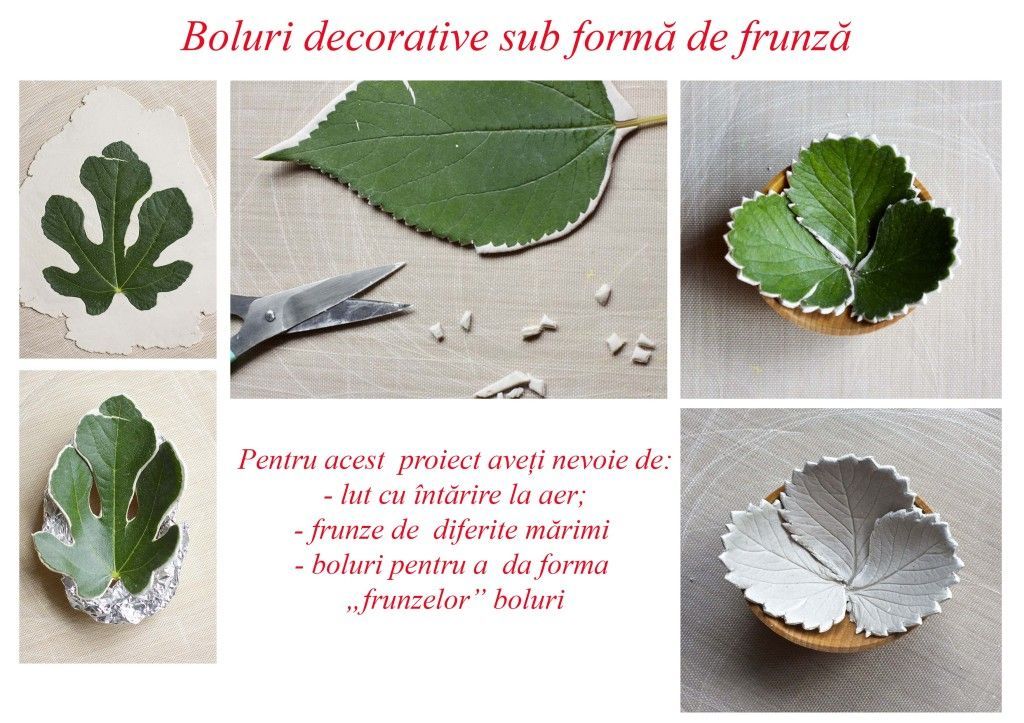
Step 1. Start by rolling out a sheet of air-drying clay (about 6 mm thick), then press a leaf onto the surface of this sheet.
Step 2. First, cut out the approximate surface of the leaf, then with scissors, carefully cut out the detailed outline of each leaf once more.
Step 3. Place the leaf, thus cut, in a bowl to give it its final shape. To better withstand the pressure, the leaf lobes can overlap.
Step 4. After drying, they can be painted or varnished according to preference.
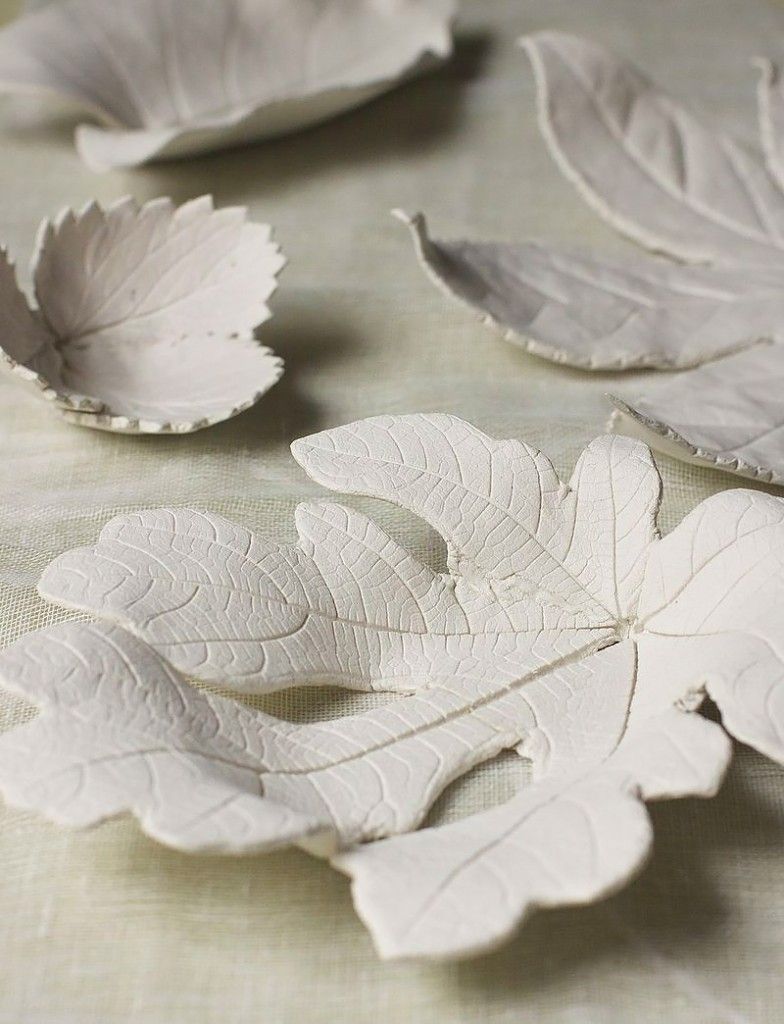
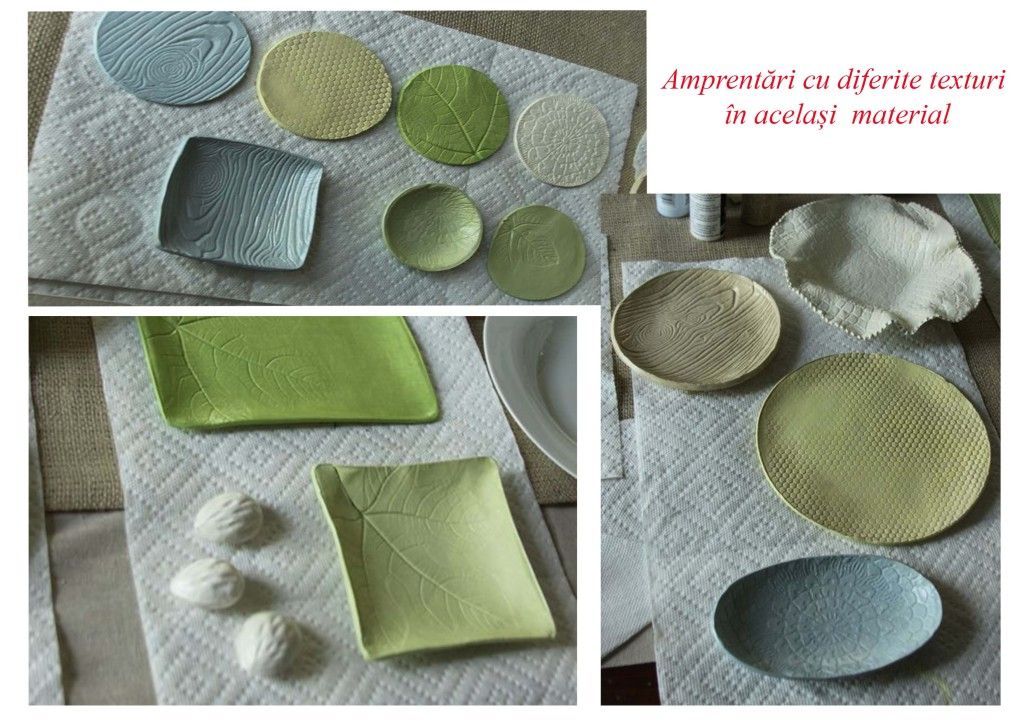
Other ideas for decorative objects using fingerprints.
Tags
- ceramics
- pottery
- ceramic techniques
- art materials
- craft history