
Byzantine Icons - The Spiritual Art of Light and Devotion
Explore the origins and evolution of Byzantine icons - sacred portraits that unite Greco-Roman tradition with Christian spirituality. Discover their symbolism, technique, and timeless influence on sacred art.
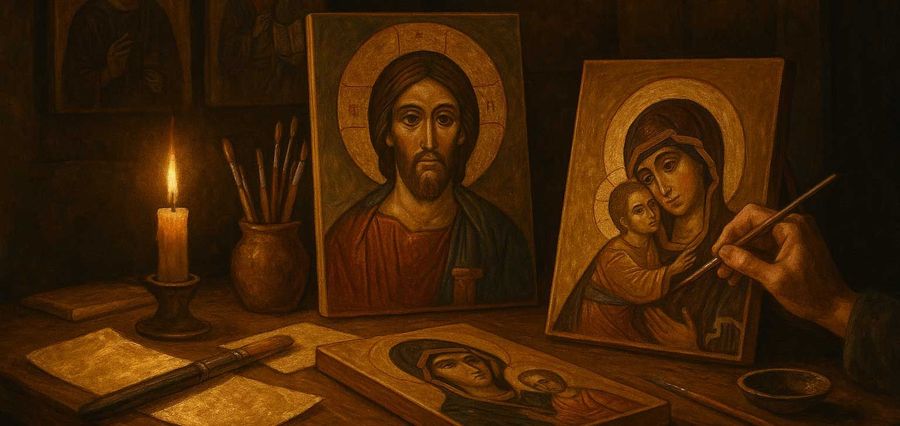
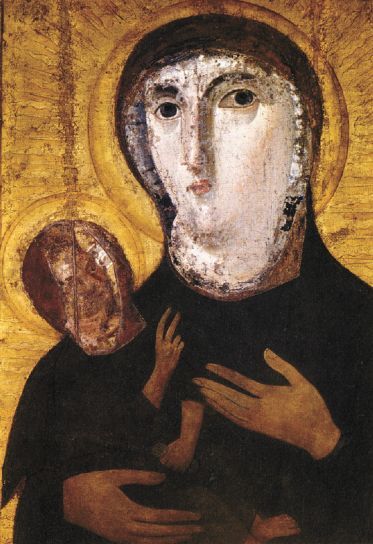
Icons have their origins in painted portraits from Greco-Roman antiquity. Greek gymnasiums exhibited portraits of magistrates, and among the Romans the tradition of official and funerary portraits was highly developed. Later, Christians adopted the customs of the society in which they lived. They began very early on by venerating images of martyrs. In the first half of the 5th century, there were icons representing Christ, the Virgin Mary, Peter, Paul, but also other saints and martyrs. Very soon these images became the object of true adoration, even being attributed beneficial virtues. In the second half of the 4th century and in the 7th century, the cult of icons developed even further, when piety towards relics was established. At that time, the religious image was seen as a very effective mediator with God. Some of these icons were even attributed a supernatural origin. “The beliefs related to icons also determined their style: fidelity to archetypes due to the care for resemblance to the model, the will to translate inner life through external appearance; hence that mixture of individualization and stylization, which stems from the tradition of Roman portraits so vivid, but which tends towards simplification, to produce a spiritual effect.” [1] Pausing to analyze an icon of the Virgin Mary holding the Child on her right arm, dated somewhere between the 5th and 8th centuries, we note a precision of the drawing, broadly outlined and refined with a fine color. “ The figure is no longer conceived as a volume with roundness, but as an assembly of several clearly drawn surfaces […]. Delicate colors are spread between the contour lines: a sometimes bright pink, but most often milky, green shadows arbitrarily arranged in such a way as to highlight the relief of the nose and chin or to emphasize the eyes, without the painter having bothered to consider where the light came from. This work owes a good part of its spirituality to the vaporous pictorial matter. (…) These deformations give the face the appearance of a modern work, which is related to the manner of Modigliani or Matisse” [2] The Virgin Mary is represented iconographically in various poses on the throne, as an empress; guiding, triumphant, with the Son on her knees or breastfeeding him. This last pose is most often repeated in Western painting.
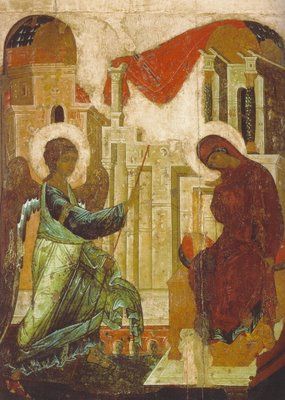
The position of the character is always frontal. " The figure of the saint was elongated, and thus dematerialized and torn from the ground. It was placed on a golden background, which removed him from real space, raising him above reality. This isolation from the world was further intensified by the unnatural coloring of the painting. Even the fragments of nature, mountains or plants, sometimes rendered in icons, were reduced to geometric or crystalline shapes, and also dematerialized, giving the impression that they belong to another world. " [3] The figures of the angels are also subject to precise iconographic norms, inspired by the Neoplatonic cosmogony. They appear dressed in mail and brocade tunics, armed with swords. The dominant composition was the frontal construction and the reverse perspective, so that the viewer's attention would be directed to the focal point of the spiritual content: the eyes of the saint, always fixed on the one who prays. For the painter, the head is the one that determines everything. The rest of the body is subordinate to it and is barely noticeable under the garments. The reverse perspective, by which larger objects and figures were placed in the background, was intended to attract the believer towards the icon. The composition and expression of the painting were devoid of tension and élan, the staticity of the image demanded an almost equal immobility in asceticism towards God.
In the 11th and 12th centuries, a linear style and gold backgrounds predominate, the figures being painted from the front, with static attitudes and a severe, ascetic expression. In the following two centuries, portable icons made of mosaic developed greatly. Also very popular were icons depicting scenes from the lives of saints, enriched with countless details from everyday life; the treatment being freer, the manner is more natural, the figures represented become less rigid, respect anatomical proportions and have more naturalness in attitude and movements.
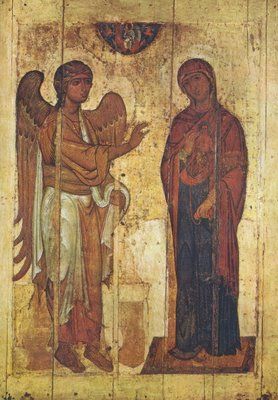
Under the Palaeologus, Byzantine painting – implicitly icons – acquires the imprint of humanism characteristic of the intellectual renaissance of that period. The chromatic range is clearer, rich in nuances, made up of a combination of very bright colors but also delicate halftones. Therefore, we can say with full justice that Byzantine art aroused the interest of Venetian painters, who always considered it as a great “School of painting”.
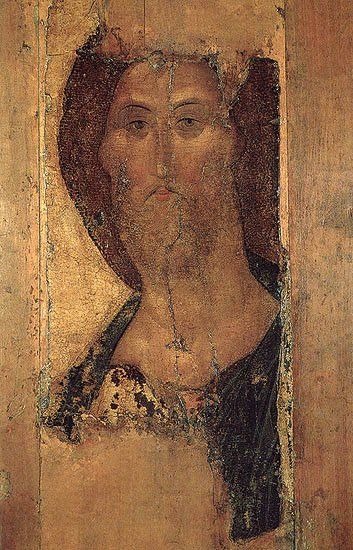
We can conclude that icons “… added a feature entirely their own: the spiritualization of the faces, transfigured by the practice of meditation and contemplation. Illuminated by the vision of God, they reflect with intensity the inner life. The serene foreheads are made to shelter elevated thoughts .” [4]
Tags
- Byzantine icons
- religious art
- sacred painting
- holy icons
- faith in art